
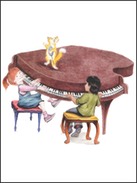
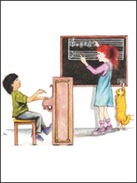
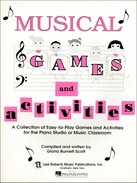

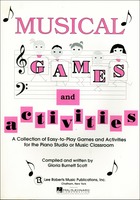
The following game, "Keyboard Orientation" is an example of an activity where beginners of any age can learn important fundamentals while also having fun. This game comes from the 96-page Musical Games and Activities (by Gloria Burnett Scott) an invaluable teacher/parent's resource in piano studios, music classrooms, and homes throughout the country.
Chapter 1. Keyboard Geography KEYBOARD ORIENTATION (pgs. 2 - 3)
Objective: Develop better sight-reading skills through the tactile feel of the keys on the piano keyboard
Student level: Beginners of all ages
Number of players: At least four
Materials needed: None
1. Four players face the keyboard. Players one and three close their eyes and try to find a group of twins, while players two and four observe.
2. Players two and four try to find a group of twins with their eyes closed, while players one and three watch.
3. The four players—continuing to alternate between the two pairs of players— try to find the triplets.
4. Then the teacher asks each pair of players to find, without looking, a twin group at the high end of the keyboard, then a triplet group at the bottom of the keyboard, the middle key of the triplet group, the bottom of a twin group, and so.
5. Finally, with eves open, each student reaches for the middle key of a triplet group and slides right onto the white key A, then plays B, and so on, until all seven letters of the musical alphabet have been played.
6. Now the teacher groups the students into two relay teams facing the keyboard. Each student quickly finds and plays A and goes to the end of the line. Then each one finds and plays B, and so on. Next, at the teacher's request, the students find and play: A-B-C, then C-D-E, E-F-G, A-B-A-G, and so on. Establish in the student's mind that, in the A-B~A-G configuration, G is easily found by going one step down the musical scale rather than six steps upward.
At some point during each lesson, ask the students to close their eyes and find A; then without opening their eyes, find C (by feeling it next to the bottom of the twins); next find F (by feeling it next to the bottom of the triplet grouping); and so on.
Mental Gymnastics: The teacher tells the class to face away from the piano with their eyes closed and to mentally picture the keyboard. He or she asks the class to give the name of the white key that is between the twins, then the name of the white key that is just above the triplet group, and so on.
HOME REINFORCEMENT:
1. Ask parents or other family members to quiz the student during the week, asking questions such as, "Which white key is just below the bottom of a triplet group?" The answer is "'F."'
2. Assign pupils to practice finding all the A's, B's, C's,
and so forth, on the piano keyboard.
Excerpted from Musical Games and Activities, by Gloria Scott Burnett.
© 1994 by Lee Roberts usic Publicatons, Inc. ALL RIGHTS RESERVED.